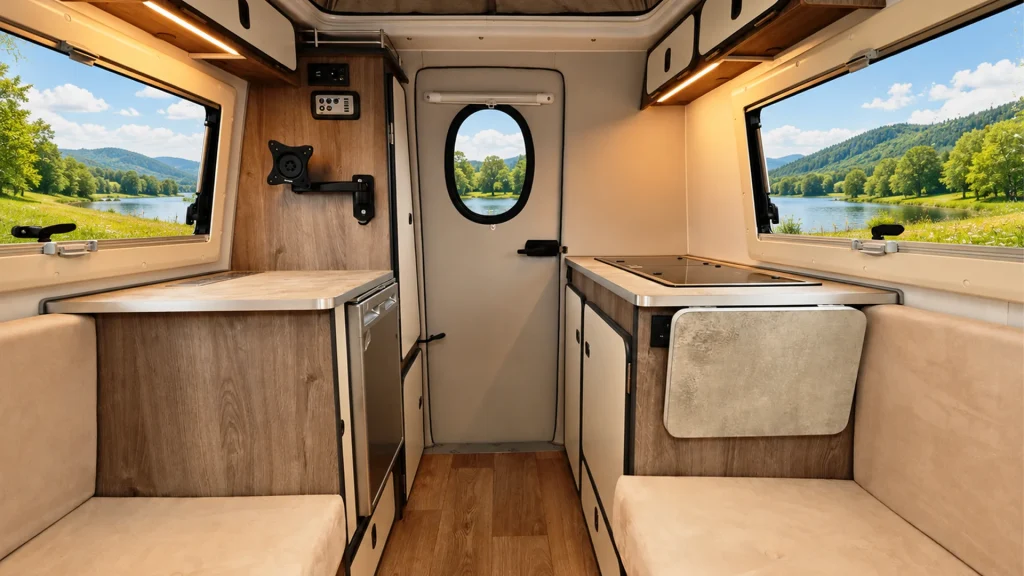
Go-Pod specifications
Go-Pod dimensions, weights & specifications
Check the key Go-Pod dimensions, weights and technical details, including external size, internal measurements, MTPLM, payload, wheels, tyres, gas bottle compatibility and storage guidance.

Interactive dimensions guide
Go-Pod dimensions, made easy.
Switch between external and internal measurements, then click a card to highlight the relevant dimension on the diagram.
External measurement
Total length: 420cm
Total length includes the Go-Pod body, drawbar and hitch.


Quick reference
Prefer the numbers in one place?
The interactive guide above is designed to make the main Go-Pod dimensions easier to visualise. If you prefer a more traditional reference table, here are the key measurements grouped together.
External dimensions
Overall length
420cm
Body length
322cm
External width
200cm
Height with pop-top closed
205cm
Height with pop-top raised
approx. 235cm
Door opening
60 × 158cm
Internal measurements
Double bed
192 × 157cm
Single beds
192 × 53cm each
Footwell
205 × 62cm
Side seats
110 × 54cm
Front seat
154 × 82cm
Standing height
183cm raised / 155cm closed
Storage & clearance
Garage clearance
allow 210cm where possible
Ground clearance
18.3cm
Front locker size
70cm wide × 50cm deep
Front locker height
50cm rear / 35.5cm front
A quick note on measurements
Because Go-Pods are made from fibreglass, small variations can occur. If you are checking a very tight garage, driveway or storage space, please allow a little tolerance and contact us if you are unsure.
Go-Pod weights
Caravan weights, explained simply.
If you’re new to caravans, terms like MiRO, MTPLM and payload can sound more complicated than they need to. Here are the key Go-Pod weight figures in plain English.
?MiRO stands for Mass in Running Order. It is roughly the caravan’s empty or factory weight before you add your own kit, luggage and optional extras.
580kg
Approx. empty / factory weight
?MTPLM means Maximum Technically Permissible Laden Mass. In plain English, it is the maximum the Go-Pod is allowed to weigh when fully loaded.
750kg
Maximum loaded weight
?Payload is the weight allowance left for your belongings and fitted accessories. It is calculated by subtracting MiRO from MTPLM.
170kg
Standard loading allowance
?Nose weight is the downward force the front of the caravan places on your car’s towball. Gas bottles and items stored at the front can increase it.
49kg
Downward force on towball
How standard payload is worked out
750kg
MTPLM
−
580kg
MiRO
=
170kg
payload
Accessories fitted to a specific Go-Pod count towards the payload, so always check the actual remaining allowance for the model you’re looking at.
Some Go-Pods are plated differently
The vast majority of Go-Pods have a plated weight / MTPLM of 750kg. Some were plated at 1,000kg if the plated weight upgrade was selected when new. This upgrade is processed at the factory and cannot be applied retrospectively.
Wheels & tyres
The key tyre details, without the guesswork.
These are the main wheel, tyre and pressure figures you may need for checking, servicing or replacing parts on a Go-Pod.
Wheel size
13 inches
Standard Go-Pod wheel size.
Tyre size
175/70 R13 86N
The standard tyre size fitted to Go-Pods, specially manufactured for trailers with reinforced walls.
Tyre pressure
35psi
Recommended tyre pressure for standard Go-Pod tyres.
Wheel nut torque
65lbs / 88Nm
Standard wheel nut torque. Alloy wheels use 95lbs / 128Nm.
Always check the tyres fitted to your own Go-Pod
A suitable alternative tyre for Go-Pods with an MTPLM of 750kg is 175/70 R13 82T. When replacing tyres, make sure the tyre is suitable for trailer use and appropriate for your specific Go-Pod.
Home storage
Store it at home, use it more often.
One of the biggest Go-Pod advantages is that many owners can keep their caravan at home. That can make spontaneous getaways easier, day-to-day checks simpler and ownership feel far less like a logistical puzzle.
Jump back to dimensionsDesigned to fit where many caravans cannot.
Go-Pods fit in many standard-size garages. The closed external height is 205cm, but we recommend allowing 210cm clearance where possible because small variations can occur.
205cm
closed external height
210cm
recommended clearance
200cm
external width
420cm
overall length
Ready when you are
Keeping your Go-Pod at home makes last-minute weekends and quick checks much easier.
More secure at home
Home storage can give you more control over security than leaving your caravan on a remote site.
Easier maintenance
Battery checks, cleaning, airing and packing are all simpler when the Go-Pod is nearby.
May help insurance
Some insurers may offer lower premiums when a Go-Pod is stored securely at home rather than on a storage site.
Tight garage clearance? A few owners have found workarounds.
Some customers with slightly less clearance have managed to gain a few extra centimetres by carefully lowering tyre pressure while manoeuvring into storage, or by gently lifting an up-and-over garage door from underneath. Only do this with care, and always reinflate tyres before towing.
Gas bottles
Compatible gas bottles
Go-Pods use compact gas bottles because the front locker space is limited. These are the common compatible options, with a few practical notes to help you choose the right bottle.

Calor Gas 3.9kg propane
The most popular choice by far and widely available nationwide. On your first purchase, you usually pay extra for the bottle; after that you swap it for a full one and pay the refill cost.
Best all-round option

Flogas 3.9kg propane
Available at many B&M stores nationwide, but there are two collar sizes. Only the 340mm height version is suitable for use with Go-Pods, so collection in person is recommended.
Check collar height

Flogas 4.5kg butane
A compatible butane option, but butane is less effective at lower temperatures. It may also require a different regulator due to the pressure difference between butane and propane bottles.
Warmer-weather option

Campingaz R907 butane
The smallest compatible bottle and widely available in Europe. It is also butane, so less effective in colder weather, and needs a Campingaz proprietary adapter for connection.
Useful for Europe
Check bottle dimensions before buying
Bottle sizes, collars and regulators can vary, so always check the exact bottle before buying. If you are unsure which gas bottle is suitable for your Go-Pod, contact us before purchasing.
Still unsure?
Need help checking a size, weight or towing detail?
If you’re comparing garage space, checking whether your car can tow a Go-Pod, or just trying to make sense of the numbers, get in touch and we’ll help you work it out before you make any decisions.
Useful things we can help with
A few minutes of advice can save a lot of measuring-tape drama later.
Checking garage or driveway fit
Understanding towing and weight limits
Working out payload and accessories
Choosing a suitable gas bottle
Ready to see a Go-Pod for yourself?
Browse the details, book a viewing or build your ideal setup in the Go-Pods configurator.